- Glacial Errata
- Posts
- Glacial Errata, No. 49
Glacial Errata, No. 49
Five Things for the Week of December 15, 2025.

Colin Dickey
December 15, 2025
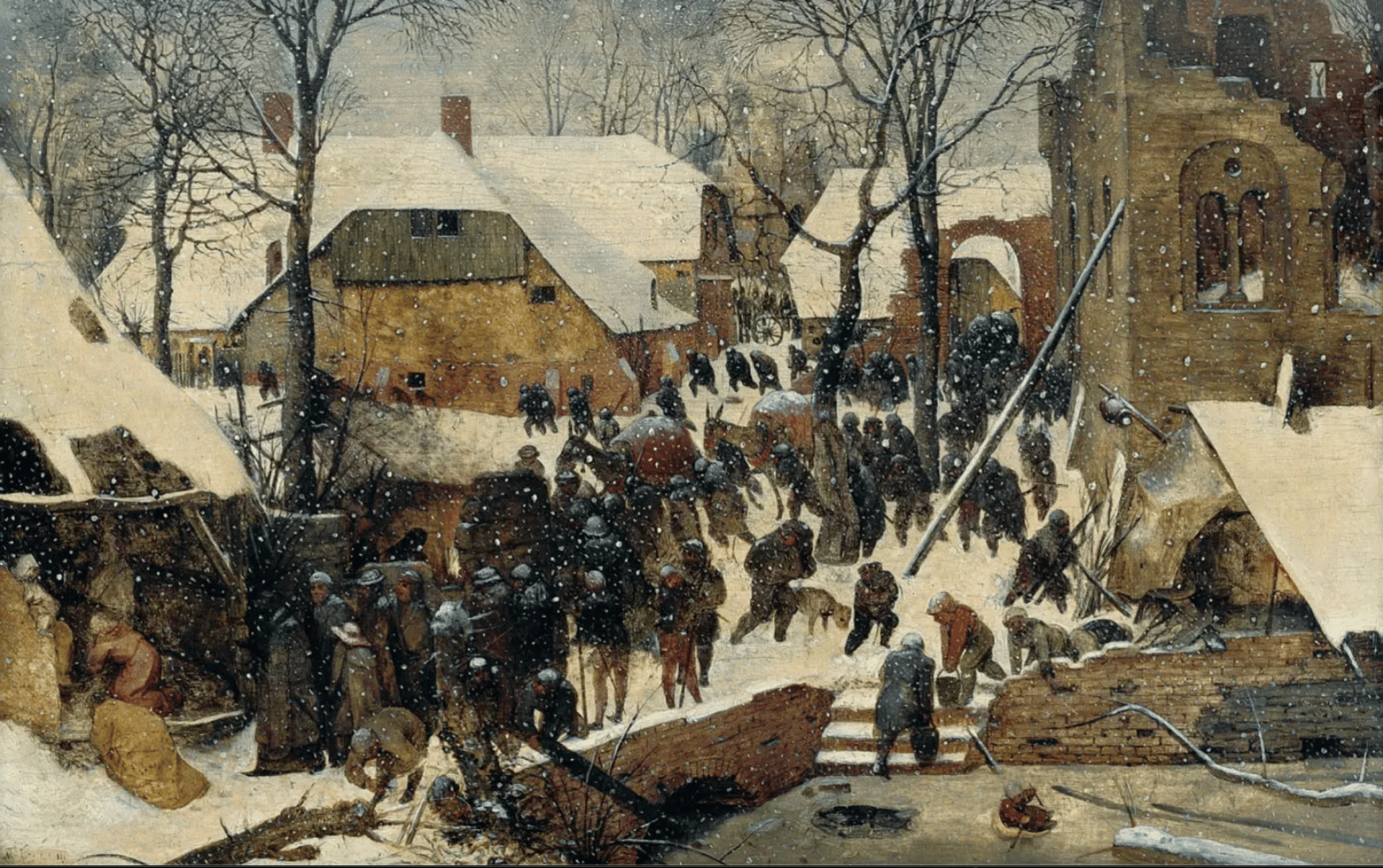
[Saturday night, it snowed in New York. The following images are from Bruegel; the quotes are from Adam Gopnick.]
One: The Adoration of the Magi, 1563
“…winter is a time of transformations in what the Canadian-born sociologist Erving Goffman calls the mirco-order of behaviour—the largely unconscious order of small manners that shape our lives and express our feelings. First, winter creates a suspension of normal rules; next, it enforces a dramatization of normal events. We act out in winter cities. When we’re cold, we stamp our feet, we shiver—we show that we’re cold…. And at the same time it seems that the small laws of urban life—parking regulations, rules about drinking in public, jaywalking—are discretely suspended. It is in some way normal or expected to ritualize our condition in winter and to suspend the mirco-order. In this sense we might say that winter is an inherently festive time, pregnant with a festival’s two impulses: to suspend the rules and to heighten the actions.”
Two: Hunters in the Snow, 1565
“…how do we incorporate a mechanical, mineral act—the fact of a season not made for us and indifferent in every sense to our existence—into our sense of time and order? How does a season produced by the tilts of poles and the presence of climate cycles that are going on in every uninhabited planet in the solar system, how could these simple physical events engage and attach themselves to our lives?”

Three: The Census at Bethlehem, 1566
“A snow-capped mountain in Switzerland, seen from the comfort of an auberge, can set off a profound chain of thought about ice and ancient history; a gentle snow in the Paris suburbs can create images that show the transience of beauty. The winter window has two sides, one for the watcher and one for the white drifts, and the experience of winter is not one or the other but both at once.”

Four: The Massacre of the Innoncents, 1567
“Yet there are two different ways in which winter touches memory: there is memory in winter and memory of winter. In the first sense we think use winter as a blank slate, the place where everything is scrubbed away…. Winter displaces us from the normal cycles of nature—nothing’s growing—and with our disjunction from nature comes or escape into the mind, which can make of nature what it will…. The second sense of memory and winter involves not memory working within winter but our memory of winter, after it is over. The snows of winter become the tangible sands of the memory clock…. Winter and cold places supply, I think, a sense of past time, and an urge to think about time passing.”

Five: Winter Landscape with Bird Trap, ca. 1601
“But a taste for winter, a love for winter vistas—a belief they are beautiful and seductive in their own way, and as essential to the human spirit and the human soul as any summer scene—is part of the modern condition. Wallace Stevens, in his poem ‘The Snow Man,’ called this new feeling ‘a mind of winter,’ and he identified it with our new acceptance of a world without illusions, our readiness to live in a world that might have meaning but that doesn’t have God.”
